What to Expect at Your Pet's First Acupuncture Session
You have heard that acupuncture can help your dog's arthritis, your cat's chronic vomiting, or your horse's back pain. Maybe your conventional vet recommended it, or maybe you found a practitioner through your own research. Either way, you are about to bring your animal to an appointment that probably feels unfamiliar — and you want to know what is going to happen.
That is completely understandable. Acupuncture is one of the most well-researched holistic modalities in veterinary medicine, with decades of clinical evidence supporting its use for pain management, inflammation, neurological conditions, and more. But knowing the science does not necessarily tell you what the experience will be like for you and your pet.
This guide walks you through a typical first acupuncture session, from the initial consultation to what happens after the needles come out.
What Is Veterinary Acupuncture?
Veterinary acupuncture involves the insertion of very fine, sterile needles into specific points on an animal's body. These points, mapped over thousands of years in Traditional Chinese Medicine and validated by modern neuroanatomy, correspond to areas rich in nerve endings, blood vessels, and connective tissue.
When a needle is placed at one of these points, it triggers a cascade of physiological responses. The body releases endorphins and anti-inflammatory compounds, blood flow increases to the targeted area, and the nervous system shifts toward a more relaxed, healing-oriented state. In Western medical terms, acupuncture modulates pain signaling, reduces muscle spasm, and promotes tissue repair. In Traditional Chinese Veterinary Medicine terms, it restores the balanced flow of energy through the body.
Both frameworks are valid, and many veterinary acupuncturists draw on both when designing a treatment plan.
Who Performs Veterinary Acupuncture?
Veterinary acupuncture should only be performed by a licensed veterinarian who has completed additional certification in acupuncture. The most recognized certifying bodies include:
- IVAS (International Veterinary Acupuncture Society) — requires approximately 100 hours of training plus a practical exam
- Chi Institute — offers certification in Traditional Chinese Veterinary Medicine, including acupuncture, herbal medicine, and food therapy
- CuraCore — provides a medical acupuncture curriculum grounded in evidence-based neuroanatomy
When choosing a practitioner, look for credentials like CVA (Certified Veterinary Acupuncturist) or similar designations after the DVM. These indicate that the veterinarian has training specifically in acupuncture, not just general practice.
You can search for certified practitioners near you using our directory.
Before the Appointment: How to Prepare
There is not much you need to do to prepare, but a few small steps can make the visit smoother:
Bring your records. If your pet has been seen by another veterinarian, bring or have records sent ahead of time. This includes bloodwork, imaging, medication lists, and any diagnosis or treatment history. The acupuncturist needs the full picture to design an effective plan.
Do not fast your pet. Unlike some veterinary procedures, acupuncture does not require an empty stomach. In fact, a light meal beforehand is usually fine — a slightly satisfied animal tends to be calmer.
Plan for extra time. A first acupuncture visit is significantly longer than a standard vet appointment. Expect 60 to 90 minutes. Follow-up sessions are shorter, typically 30 to 45 minutes.
Bring a favorite blanket or bed. Many clinics have comfortable spaces for treatment, but a familiar item from home can help an anxious pet settle in more quickly.
Keep exercise light that day. Avoid strenuous activity before and after the session. The body is doing internal work during and after acupuncture, and rest supports that process.
What Happens During the First Visit
Step 1: The Intake Consultation (20-30 minutes)
The first visit begins with a thorough conversation — more thorough than most conventional vet visits. The acupuncturist will ask about:
- Current symptoms and when they started. Pain, mobility issues, digestive problems, behavioral changes, energy levels.
- Medical history. Surgeries, injuries, chronic conditions, medications, supplements.
- Diet and nutrition. What your pet eats, how much, and how they respond to it. Holistic practitioners often view diet as foundational to health.
- Daily routine and environment. Activity level, sleeping habits, stressors, household dynamics. These factors influence health in ways that conventional medicine sometimes overlooks.
- Temperament. How your pet responds to handling, new environments, and other animals. This helps the practitioner plan the session and choose appropriate points.
If the practitioner is trained in Traditional Chinese Veterinary Medicine, they may also examine your pet's tongue (color, coating, moisture) and feel the pulses at specific points on the body. These are diagnostic tools in TCVM that provide information about the patient's internal balance.
Step 2: The Physical Exam
The acupuncturist will perform a hands-on physical examination, paying particular attention to:
- Pain points and muscle tension. They will palpate along the spine, limbs, and major muscle groups, noting areas of tightness, tenderness, or guarding.
- Range of motion. Gently moving joints through their full range to assess stiffness or discomfort.
- Gait and posture. Watching your pet walk, stand, and shift weight. Subtle asymmetries can reveal underlying pain or neurological issues.
- Trigger points and acupuncture point sensitivity. Certain acupuncture points become reactive when there is a problem in the associated area. The practitioner may press along meridian lines and note which points produce a response — a twitch, a flinch, or a turn of the head.
This assessment tells the practitioner which acupuncture points to use and helps them understand the pattern behind your pet's symptoms.
Step 3: Needle Placement (15-25 minutes)
Now comes the part most pet owners are nervous about. Here is what actually happens:
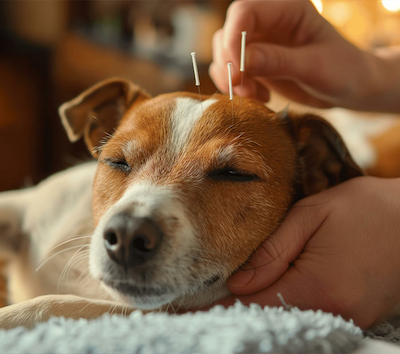
The needles are very small. Acupuncture needles are hair-thin — much thinner than the needles used for injections or blood draws. Most are 0.16 to 0.25 millimeters in diameter. Many animals do not react at all when they are inserted.
Placement is precise. The practitioner selects anywhere from 4 to 20 points depending on the condition being treated. Common points are located along the back, hips, shoulders, legs, and head. Each point is chosen for a specific therapeutic reason based on the exam findings.
Most pets tolerate it well. Dogs often settle down within the first minute or two, and many become visibly relaxed — lowering their head, sighing, even falling asleep. Cats can be more variable, but experienced practitioners know how to work with feline patients using fewer needles, gentler technique, and a calm environment.
The needles stay in for 10 to 20 minutes. Once all needles are placed, the pet rests quietly while they do their work. The practitioner typically stays nearby, monitoring for any signs of discomfort and occasionally adjusting needle placement. Some practitioners use gentle manual stimulation of the needles, rotating them slightly to enhance the effect. Others may attach small electrodes for electroacupuncture, which delivers a mild electrical current through the needles to provide stronger pain relief and muscle relaxation.
Removal is quick and painless. When the session is complete, the needles are removed gently. There is no bleeding or soreness at the insertion sites.
Step 4: Post-Treatment Discussion
After the needles are removed, the practitioner will discuss:
- What they found and how it relates to your pet's symptoms.
- The treatment plan going forward — how many sessions they recommend, how frequently, and what to expect in terms of improvement.
- Home care recommendations. This might include dietary changes, supplements, gentle exercises, or environmental modifications.
- What to watch for after the session.
What Happens After the Session
Most pets are noticeably relaxed after acupuncture — sometimes deeply so. It is common for dogs to sleep more than usual for 24 to 48 hours after a session. This is normal and actually a good sign. The body is processing the treatment.
Some pets show immediate improvement in their symptoms. Others, especially those with chronic conditions, may not show noticeable changes until after two or three sessions. Occasionally, symptoms may briefly worsen before improving — practitioners call this a healing response, and it typically resolves within a day.
What to do after the appointment:
- Let your pet rest. Avoid long walks, rough play, or strenuous activity for the rest of the day.
- Offer fresh water. Some pets drink more than usual after treatment.
- Note any changes. Keep a simple log of what you observe in the hours and days following the session — energy level, appetite, mobility, pain behavior. This information is valuable for the next visit.
- Do not adjust medications without consulting your vet. Acupuncture works alongside conventional treatments, not as a replacement. Any changes to medication should be discussed with your veterinary team.
What Conditions Does Veterinary Acupuncture Treat?
Acupuncture is not a cure-all, but it has strong clinical evidence for the following:
Pain and musculoskeletal conditions — arthritis, hip dysplasia, intervertebral disc disease, post-surgical pain, muscle injuries, and age-related stiffness. Pain management is the most common reason pets are referred for acupuncture.
Neurological conditions — nerve paralysis, degenerative myelopathy, vestibular disease, and seizure disorders. Acupuncture can support nerve function and reduce the frequency and severity of neurological episodes.
Gastrointestinal issues — chronic vomiting, diarrhea, inflammatory bowel disease, appetite loss, and nausea. Acupuncture has been shown to regulate gut motility and reduce GI inflammation.
Respiratory conditions — chronic cough, feline asthma, and upper respiratory issues. Specific acupuncture points have documented effects on airway function and immune response.
Anxiety and behavioral issues — separation anxiety, noise phobia, general nervousness. By shifting the nervous system toward a parasympathetic (rest-and-digest) state, acupuncture can meaningfully reduce stress-related behaviors.
Cancer support — while acupuncture does not treat cancer directly, it is widely used to manage pain, nausea from chemotherapy, appetite loss, and overall quality of life in oncology patients.
How Many Sessions Will My Pet Need?
This depends on the condition being treated and how long it has been present.
- Acute conditions (recent injury, post-surgical pain): 2 to 4 sessions, often spaced a week apart.
- Chronic conditions (long-standing arthritis, recurring GI issues): 4 to 8 initial sessions, typically weekly, then tapering to every 2 to 4 weeks for maintenance.
- Quality-of-life support (senior pets, cancer patients): Ongoing sessions every 2 to 4 weeks, adjusted based on response.
Most practitioners recommend committing to at least 3 to 4 sessions before evaluating whether acupuncture is working for your pet. A single session is rarely enough to assess the full benefit.
What Does It Cost?
Acupuncture pricing varies by region and practitioner, but typical ranges are:
- Initial consultation + first treatment: $150 to $300
- Follow-up sessions: $75 to $200
- Packages (4 to 6 sessions): Some practices offer bundled pricing at a reduced per-session rate
Some pet insurance plans cover acupuncture when performed by a licensed veterinarian. Check with your provider — coverage for complementary therapies has been increasing in recent years.
Questions to Ask Before Booking
If you are considering acupuncture for your pet, here are good questions to ask a prospective practitioner:
- What is your acupuncture certification, and where did you train?
- How many years have you been practicing veterinary acupuncture?
- Have you treated animals with my pet's specific condition?
- How many sessions do you typically recommend?
- Do you use acupuncture alone or in combination with other modalities?
- Will you coordinate with my pet's primary veterinarian?
The answers will help you assess both the practitioner's qualifications and whether their approach is a good fit for your pet.
Finding a Certified Veterinary Acupuncturist
Not every veterinarian who offers acupuncture has the same level of training. Look for practitioners with specific certifications from recognized programs like IVAS, Chi Institute, or CuraCore.
Our directory of holistic veterinarians makes it easy to search for acupuncture-certified practitioners by location. You can also filter by other modalities if you are interested in a multi-modal approach that combines acupuncture with herbal medicine, chiropractic, or nutritional therapy.
Find a veterinary acupuncturist near you →
The Bottom Line
Veterinary acupuncture is not fringe medicine. It is a well-researched, professionally regulated treatment that thousands of veterinarians practice worldwide. For many chronic conditions — especially pain, neurological issues, and gastrointestinal problems — it offers real relief that conventional medicine alone may not fully provide.
If you have been curious about trying it for your pet, the first session is the hardest step. Now you know what to expect: a thorough consultation, a gentle treatment, and a pet who will probably sleep very well that night.
Join the Conversation
Have thoughts on this topic? Connect with other holistic pet parents in our community forum.
Join Holistic Pet Parents